Guides
CAISO Storage Operations: The Complexity of Doing it Well
Guides
Maximize revenue by capturing the full IFM → RTD spread
With the recent heatwave, RTD prices in CAISO have been clearing abnormally high almost every night of the last week. Given CAISO’s three-tier revenue settlement structure, capturing these prices requires an incredibly strategic bid/offer strategy.
Let’s take an evening late last week that nicely illustrates this CAISO settlement nuance that is unique from ERCOT – and every trader operating in CAISO should have top of mind.
The setup: The asset had a discharge offer clear in the Integrated Forward Market (IFM) through a window where Real-Time Dispatch (RTD) prices spiked — $54/MWh in IFM, running up to $994/MWh in RTD. At first glance, one might think this automatically means you miss out on ~$940/MWh of opportunity.
This would be the case in ERCOT, and most other U.S. energy markets, which have two-tier revenue settlement. If you clear a discharge bid at $54/MWh in the Day Ahead Market (DAM), ERCOT’s equivalent of CAISO’s IFM, that is what you will pocket – so long as you are able to deliver on the obligation. On the flip side, in these two-tier markets if you are short energy, you are on the hook to pay the $940/MWh spread.
However, given CAISO’s three distinct markets – IFM, FMM, and RTD – that isn’t the case, and may catch CAISO operators by surprise.
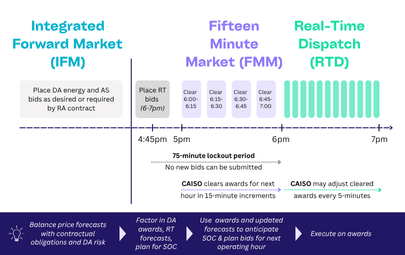
Your IFM award settles against the difference between the IFM and FMM price. Your FMM award settles against the difference between the FMM and RTD price. Finally, your actual physical energy delivery / withdrawal settles at the RTD price.
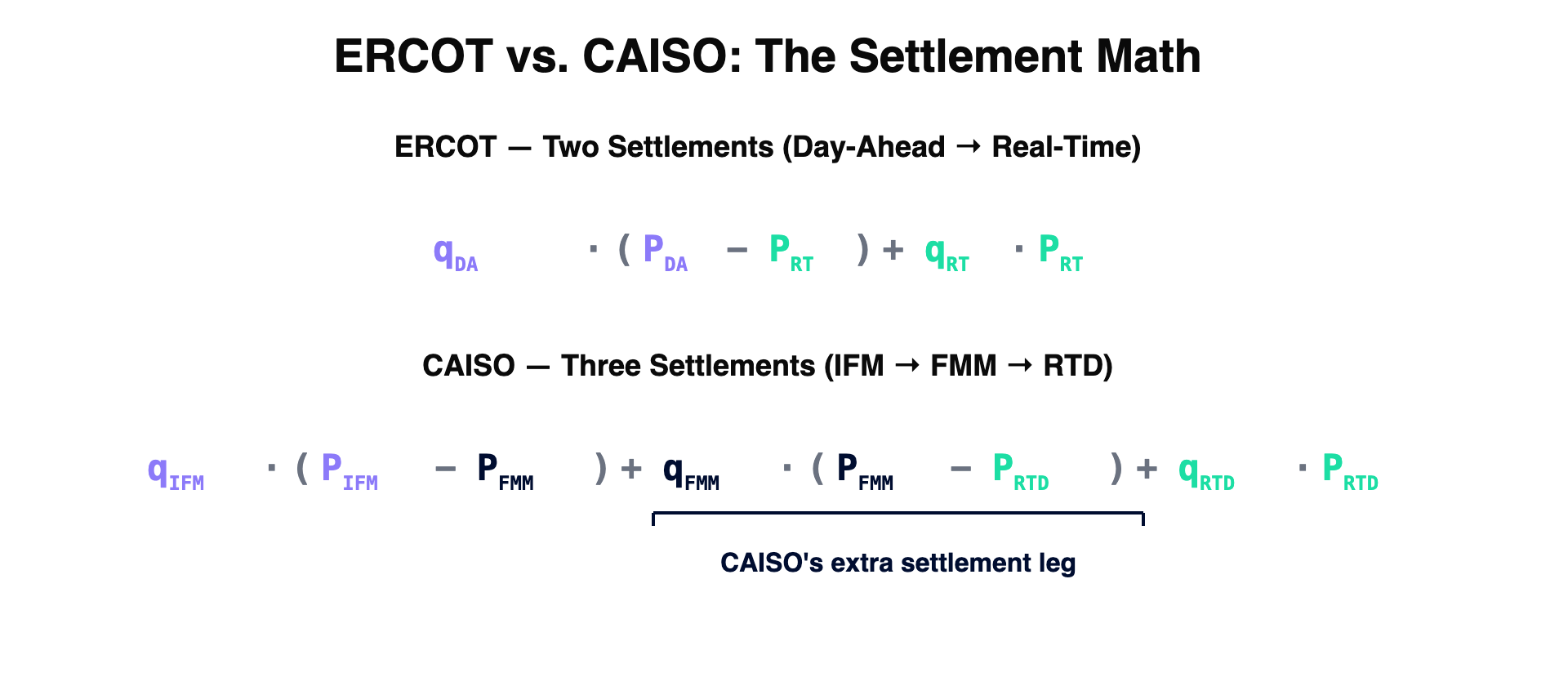
In CAISO, you still have a shot at the RTD price. You get exactly one real-time offer, and it applies to both FMM and RTD. To capture the spike, that offer has to clear in RTD but not in FMM.
Price it too low, and it clears in FMM and RTD, meaning you only capture the IFM price, which was $54/MWh. Price it too high, and it clears in neither market, causing you to miss your RT discharge entirely, and owe the market for the IFM obligation you never delivered on at the difference between the FMM and IFM.
To maximize revenue, you need to collect the IFM <> RTD spread by placing a real-time price-quantity bid priced specifically to clear in RTD but not in FMM. Since the same real-time bid curve governs both markets, this means threading a needle — pricing your offer between where you expect FMM to clear and where you expect RTD to clear, so only the RTD spike pulls it into the money.
With the strategic real time bid, we were able to capture $54 (IFM) – $93 (FMM) + $994 (RTD) = $955/MWh – about 24x higher than simply getting the IFM<>FMM spread. In practice, we sold energy in the IFM, bought it back in the FMM, then sold it again in the RTD.

You place a RT offer that is below the FMM clearing price
You deliver the energy you sold in the IFM and capture the price it sold for = $54/MWh.

Your RT offer falls between the FMM and RTD clearing prices
You sell energy into the RTD so effectively capture IFM-FMM+RTD = $955/MWh
Your RT offer is above the RTD clearing price
In this case, you do not clear in RT and therefore owe IFM-FMM = -$39/MWh
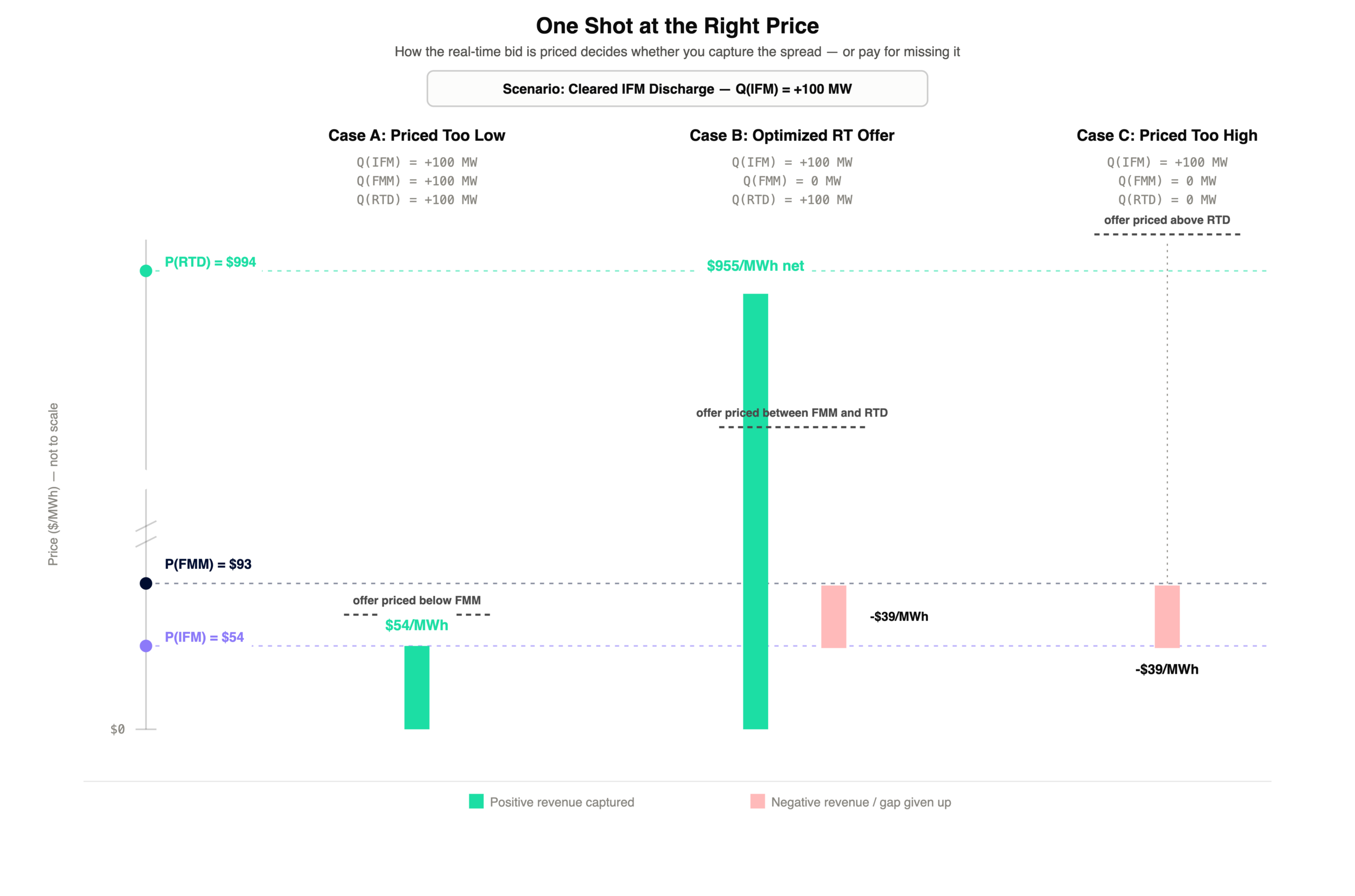
On this day, the spread was so wide that threading that needle ($93 < RT offer < $994) may not seem like a particularly difficult feat. However RTD spikes happen so rarely in CAISO that the risk of not clearing into either RT market and forgoing RT discharge, which results in having to pay the IFM-FMM imbalance price, while also under-cycling the battery, is high. Repeatedly submitting bids you don’t intend to deliver on can also draw scrutiny, and penalties, from the ISO. This makes the need for rigorous optimization high.
If we had a charge award at the time of a RTD spike, the risk and opportunity would look a bit different. Rather than the risk of being short energy and having to pay the almost quadruple digit price, there is an opportunity to capture the wide spread. But it is more challenging than it would be in a market like ERCOT’s where you pocket that spread by essentially doing nothing (neither charging nor discharging).
If you clear an FMM charge position, and your RTD output tracks your FMM schedule, you only realize the IFM price. However, if you clear an FMM charge leg but do not physically deliver, you would be able to capture the -$54 (IFM) + $994 (RTD) = $940/MWh spread.
Guides
CAISO EDAM and DAME: What Storage Operators Need to Know
03/12/26
Guides
Demystifying CAISO’s bidding timelines
10/21/25
Case Studies
[Case study] Grid-Enhancing Optimization with White Pine Renewables & PG&E
11/18/25
Guides
A Trader’s Guide to Controlling Storage Optimization Strategy
09/03/25
Guides
Operating Storage in ERCOT vs. CAISO
10/08/25

Guides
Path to Go-Live: Key Steps for Storage Assets in CAISO
09/23/25
Guides
08/09/23
Guides
CAISO Storage Operations: The Complexity of Doing it Well
Guides
CAISO EDAM and DAME: What Storage Operators Need to Know
03/12/26
Guides
Demystifying CAISO’s bidding timelines
10/21/25
Case Studies
[Case study] Grid-Enhancing Optimization with White Pine Renewables & PG&E
11/18/25
Guides
A Trader’s Guide to Controlling Storage Optimization Strategy
09/03/25
Guides
Operating Storage in ERCOT vs. CAISO
10/08/25
Guides
Path to Go-Live: Key Steps for Storage Assets in CAISO
09/23/25
Guides
08/09/23