ERCOT Storage Performance
ERCOT Storage Performance | January 2026
Looking back at storage asset operations and performance outcomes from January 2026.
January was RTC+B’s first full month of operations, and for most of it, the market was quiet. Then the storm hit.
Winter Storm Fern hit Texas January 24th–26th, and the 25th and 26th rewrote what had been shaping up as a low revenue opportunity month. For the operators who captured those days, it wasn’t a strong finish to a decent January. It was the whole thing.
That concentration of revenue tells a story about what ERCOT rewards right now, and who was positioned to receive it.
Revenue outcomes
Revenue bounced back hard from December — 2.5x higher for the median asset and 7.5x higher for the top earner. Nearly all of that revenue was concentrated in two days. The top earner made 98% of its January revenue during the peak Winter Storm Fern days.
- Highest earning asset made $22.46/kW, while the top 50 revenue generators averaged $6.55/kW
- Median asset brought in $3.23/kW, with the fleet average higher at $3.50/kW
- Real-Time (RT) Energy made up the majority of revenue at 43%, with Day-Ahead Ancillary Services (DA AS) trailing behind at 38%
Asset performance
The revenue recovery didn’t tell the whole story though. DA TB2 capture actually fell, with the median asset capturing 10% less than in December. The fleet is still adapting to what good day-ahead positioning looks like post-RTC+B, and January didn’t change that trajectory.
What it did reveal was a divide in how operators approached the storm. The top earners had conviction going into those two days, taking large positions in the Day-Ahead Market (DAM). For those who held back, the RT opportunity they were anticipating never matched what was already priced into the DAM.
- Top performing asset captured 145% of its DA TB2 opportunity, and the top 50 averaged 72%
- Median asset captured 34%, with the fleet average slightly higher at 39%
Asset performance by duration
Duration played its expected role in shaping how assets earned in January, with short duration assets anchoring in DA AS and long duration assets leaning into RT Energy. But within each bucket, the top performers were making choices that the rest of the fleet wasn’t.
Breakdown by asset duration:
- Short duration assets (≤1.0 hours) drew 59% of their revenue from DA AS in January, but the top 10 within that group pushed that figure to 70%. The DA AS premium was there for everyone throughout January. The difference was how hard the top performers were willing to commit to it.
- Mid-duration assets (1.1–1.6 hours) showed the most balanced revenue mix of any group, with RT Energy, DA Energy, and DA AS all playing a meaningful role. The top 10 within the mid-duration assets followed the same pattern as their short-duration peers, leaning harder into DA AS than the rest of the group.
- Long duration assets (>1.6 hours) leaned heavily into RT Energy, which made up 52% of their revenue. But zoom into the top 10 and the picture changes as RT Energy’s share shrinks, and DA Energy takes a significant jump. Long duration gave those operators something shorter assets didn’t have – enough SOC to take a strong DA position and keep RT optionality alive at the same time.
Winter Storm Fern
Winter Storm Fern brought cold temperatures and icy conditions to Texas January 24th–26th. ERCOT issued a Weather Watch and was forecasting record-breaking load, expected to peak the morning of January 26th. The setup looked like a classic scarcity event — high load, a stressed grid, RT prices potentially running to the cap.
It didn’t play out that way. Load came in 8–10GW below forecast. Wind overproduced by 2–3GW overnight. The RT spikes most of the fleet was positioned for never arrived at scale — and the operators who had bet on DA were the ones who came out ahead.
We break down exactly how the storm unfolded, what the fleet did, and what strong bidding approaches looked like in our Winter Storm Fern deep dive.
*Top earners defined as highest $/kW
**Top performers defined as highest percent of DA TB2 captured
-
ERCOT Storage Performance
Winter Storm Fern Performance | ERCOT
04/16/26
-
ERCOT Storage Performance
December 2025 Performance | ERCOT
03/20/26
-
Case Studies
Capturing ERCOT’s first post-RTC+B price spike
12/22/25
-
ERCOT Storage Performance
November 2025 Performance | ERCOT
02/18/26
-
ERCOT Storage Performance
October 2025 Performance | ERCOT
01/14/26
-
ERCOT Storage Performance
Q3 2025 Performance | ERCOT
12/16/25
-
ERCOT Storage Performance
September 2025 Performance | ERCOT
12/15/25
-
ERCOT Storage Performance
August 2025 Performance | ERCOT
11/19/25
-
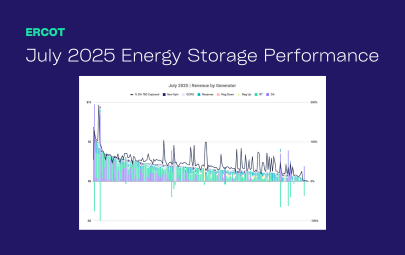
ERCOT Storage Performance
July 2025 Performance | ERCOT
10/15/25
-
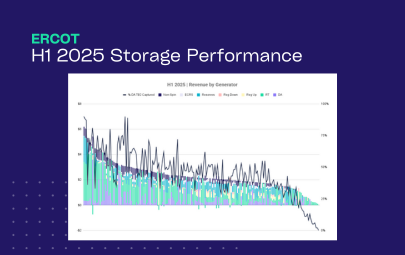
ERCOT Storage Performance
H1 2025 Performance | ERCOT
09/16/25
-
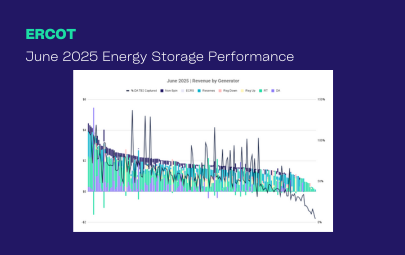
ERCOT Storage Performance
June 2025 Performance | ERCOT
09/16/25
-
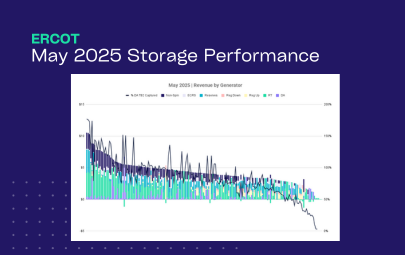
ERCOT Storage Performance
May 2025 Performance | ERCOT
08/12/25
-
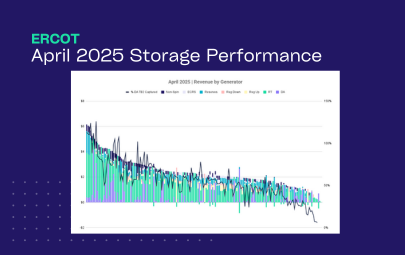
ERCOT Storage Performance
April 2025 Performance | ERCOT
07/15/25
-
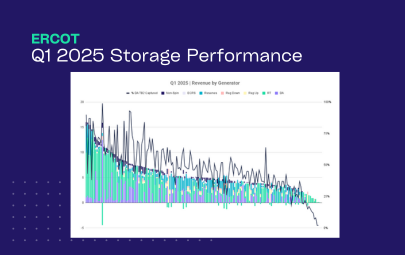
ERCOT Storage Performance
Q1 2025 Performance | ERCOT
06/26/25
-
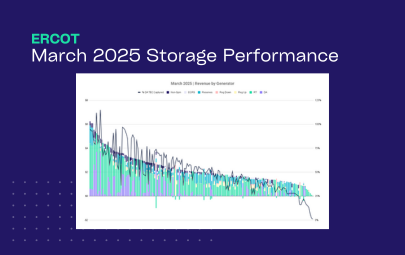
ERCOT Storage Performance
March 2025 Performance | ERCOT
06/17/25
-
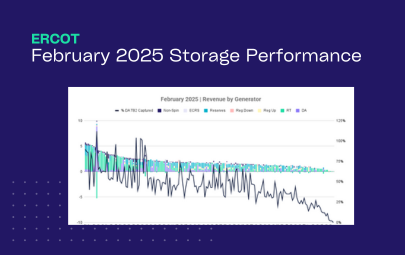
ERCOT Storage Performance
February 2025 Performance | ERCOT
05/13/25
-
ERCOT Storage Performance
January 2025 Performance | ERCOT
04/28/25
-
ERCOT Storage Performance
2024 Storage Performance | ERCOT
04/09/25
-

Guides
Benchmarking Energy Storage Performance in ERCOT: What Good Looks Like
02/24/25