Guides
A Trader’s Guide to Controlling Storage Optimization Strategy
Guides
Automation and control shouldn’t be a tradeoff. With the right tools, teams can operate more assets with more confidence, without giving up performance or the ability to act on their own market expertise.
Storage operators are often asked to choose between automation and control — hand the keys to a black box solution, or keep everything in-house and get bogged down in the day-to-day. The best operating teams have realized that this does not have to be a binary. With the right tools, they can move across three modes of control, and benefit from their optimizer’s advanced optimization capabilities in all of them.
We often analogize it to driving. Default to autopilot, which has the optimizer develop and execute the full operating strategy on its own. Shift into GPS mode when you want to input specifics to guide the optimizer’s behavior – avoid highways, take a specific bridge — and the optimizer finds the best way to get there inclusive of the parameters. Or take the reins with manual mode so you’re in the driver’s seat, editing or placing individual bids yourself.
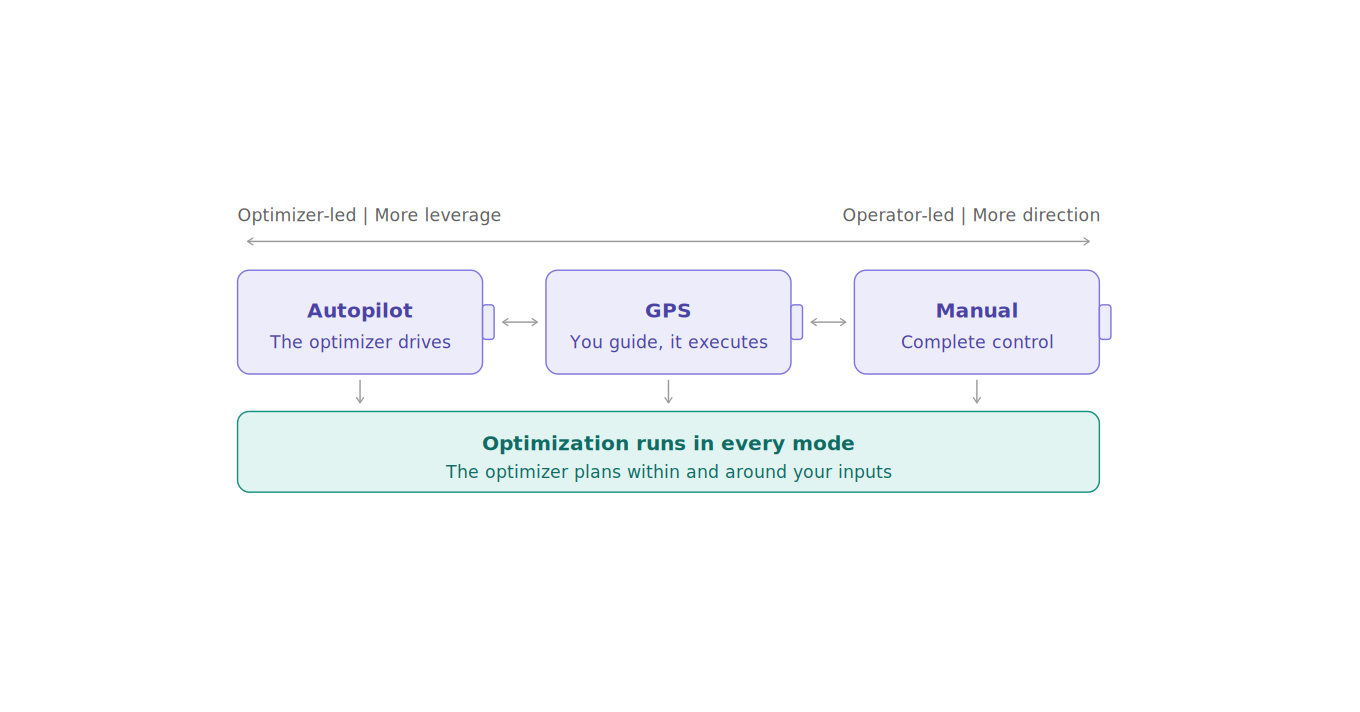
The common thread across all three: optimization continues within and around whatever you input. Exercising control doesn’t mean switching the intelligence off.
Autopilot
Letting the platform run your battery on autopilot is always an option. And can be a great option for teams looking to maximize performance while reducing operational overhead. And let’s be real, whether your team is big or small, new to storage or highly sophisticated, who doesn’t want to reduce the operational burden and free up capacity for more strategic efforts?
With autopilot mode, you still set the foundations upfront – warranty limits, risk tolerance, etc. – similar to selecting the color of your car, or fabric of your seats. Then on the day-to-day, the optimizer develops and executes an operating strategy that accounts for these foundational preferences and incorporates data from continuously updating price forecasts, market rules, and its view of future buying and selling opportunities. Battery owners can be entirely hands-off on the day-to-day, which means they can operate more assets, more effectively, with higher ROI, and without compliance risk.
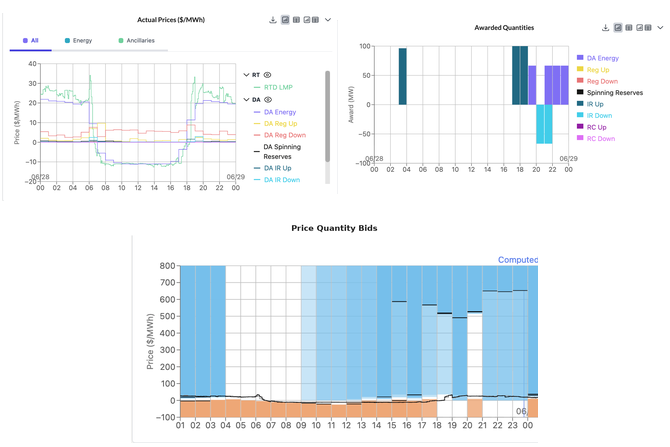
On your average and most frequent type of operating day, the optimizer can find opportunities for incremental revenue. Take June 28th in CAISO’s NP15. Energy prices followed a fairly predictable duck curve, with Fifteen-Minute Market (FMM) and Real-Time Dispatch (RTD) prices at a premium to Day-Ahead (DA) in most of the highest-priced intervals. Tyba’s optimizer placed a few strategic DA AS bids to draw capacity payments without overcommitting the asset, given the forecasted opportunity in RT. During the operating day, it then discharged into the morning and evening peaks, and charged midday when prices were negative – maximizing revenue and TB4 capture across the day.
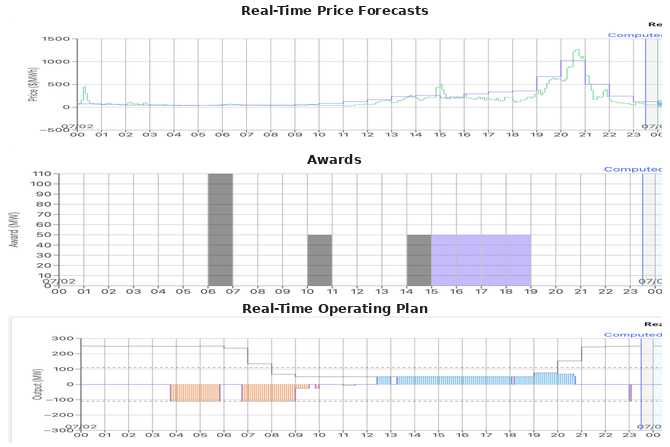
Take July 2, 2026 in MISO. With the heatwave, many were expecting energy price volatility – and the market delivered. Locational Marginal Prices (LMPs) crossed into the quadruple digits in the evening – and the premium flipped between DA and RT energy. Tyba’s optimizer navigated the day, adhering to all MISO’s nuanced market rules while still maximizing performance.
We autonomously charged the battery when prices were low midday, delivered on DA awards that strategically cleared based on DA forecasts, and discharged what was left in the battery into the later high RT energy prices. In addition to making compliance a given, which frees up team capacity (especially in a market like MISO where operating compliantly is complex and time consuming for individuals), the automation unlocked the agility and speed required for top performance.
GPS
Larger teams that want to be more hands-on often shift into GPS mode. They set the destination — inputting preferences or guidelines that drive toward a desired behavior — and rely on the platform to find the best route there. Direction can be given at different altitudes, too. Whether you want to target a specific SOC heading into a targeted window, or set price floors and ceilings for energy and AS bids before a day where you are anticipating high volatility, it is straightforward to act on your point of view.
Consider that same July 2nd in MISO. An operator anticipating elevated evening prices may have wanted to reserve all of the battery’s energy for that window. In the days prior, they could log a high Target State of Energy (SOE). That single input tells the optimizer to ensure the battery is fully charged heading into the forecasted high-price intervals — ready to discharge if prices warrant it — while leaving it to the optimizer to determine the cheapest times to charge in advance.
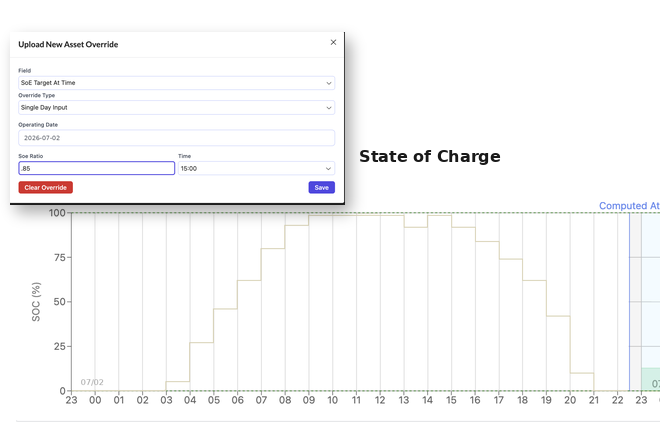
That input could be combined with a limit on DA energy offers to keep the asset unencumbered, or setting discharge price floors to ascribe a higher value to energy output on that day, or any number of other parameters. Each one is an instruction that expresses the operator’s market view. And as forecasts update and conditions shift, the optimizer does what a good GPS does — recalculates the route, continuously finding the best path to the destination you set.
Manual
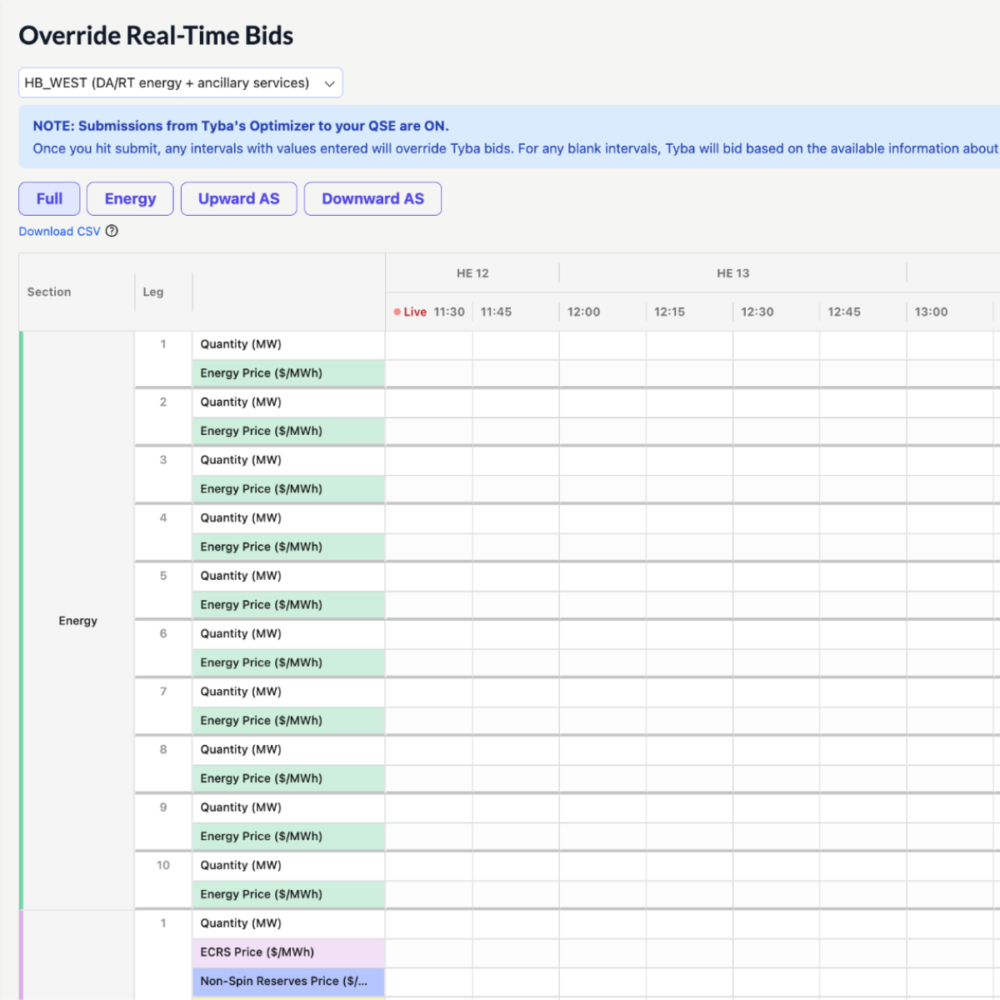
In certain instances, traders want complete control – so they can be prescriptive about the times and/or price levels at which bids are submitted. When this is the case, they shift into manual mode and edit the suggested bid plan directly, or input new bids for any market product.
Perhaps on July 2nd the operating team had strong conviction that RT energy prices would clear north of $300/MWh in the evening. To ensure their battery did not discharge too early, or into price prints that they don’t deem worth it, they may manually edit bids for a 2-3 hour window surrounding the anticipated peak. For example, maybe they submit a bid for $300/MWh at 6pm, $275/MWh at 7pm, and $200/MWh at 8pm, stepping the floor down as the window closes to ensure the energy still moves before the opportunity passes.
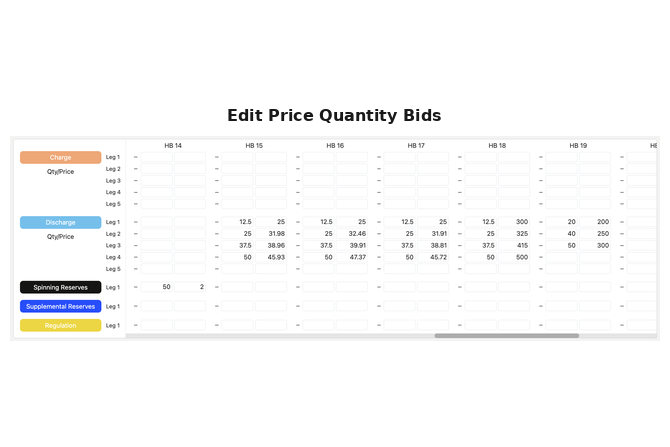
In a well-built platform, those bids are easily input, automatically passed to the market, and don’t pause the optimization. The operating plan adjusts around the manual bids – holding adequate SOE so the battery can capture those hours if prices hit, restructuring the rest of the bid plan if needed, and picking the optimization right back up coming out of the interval based on the ending SOE and forecasted future opportunities.
The bids stay locked. Everything around it is still optimized.
Optimization can run on autopilot when an operator wants leverage, they can layer in guidance when they have a view, and take the wheel when their level of conviction warrants it. And in all three modes, Tyba keeps optimizing around operator inputs. The result is a team that can operate more assets with more confidence, without giving up performance or the ability to act on their own market expertise.