Two front-of-meter batteries are combining distribution deferral contracts and flexible interconnection to provide grid relief.
When PG&E issued the second solicitation for its Distribution Infrastructure Deferral Framework pilot in late 2023, most bidders proposed aggregated fleets of small, behind-the-meter batteries in homes and businesses. White Pine Renewables took a different — and more complicated — track.
The small San Francisco-based solar and storage developer, founded in 2020 by former Cypress Creek executives, saw the pilot as an opportunity to build grid-scale systems that could not only meet the pilot’s targeted local grid needs but also participate in California ISO’s day-ahead energy market.
The DIDF pilot was originally designed to procure primarily behind-the-meter resources to avoid or defer infrastructure upgrades. The program sought resources in key locations around the state to target specific grid constraints on the distribution grid.
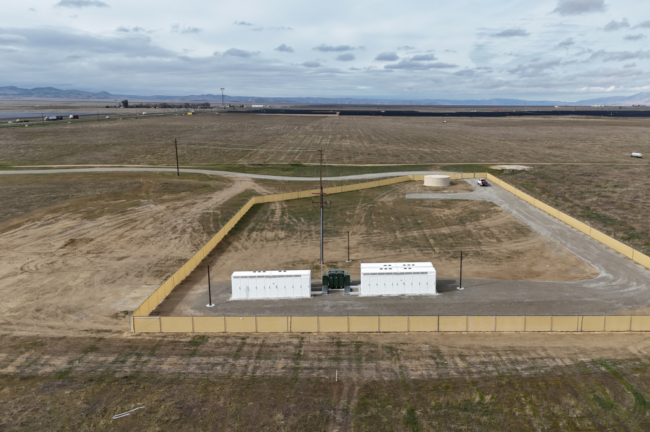
Less than nine months after its first bid was selected, White Pine brought a 1-megawatt Tesla lithium-iron-phosphate battery online near Bakersfield. That was much faster than the roughly 18 months it would have taken PG&E to complete a traditional infrastructure upgrade to that feeder. But it was also several months slower than the pair had initially anticipated.
The Lake View Project was designed to meet a relatively straightforward request from PG&E: discharge 1 MW for three hours during summer peak demand periods to relieve stress on a constrained distribution feeder. But the feeder’s existing voltage issues created a problem: White Pine couldn’t freely charge the battery without worsening the issue.
Upgrading the feeder to accommodate the battery would have been slow and costly. It would also have undermined the purpose of the deferral project in the first place, explained Joe McLean, executive vice president of technology and business development at White Pine.
“It was sort of a chicken or the egg thing, because we were installing these batteries to be able to offset those upgrades,” McLean explained.
In the end, the solution was in yet another PG&E pilot program, known as Flex Connect. Under that program, customers whose load can be flexible during peak periods can connect to the grid more quickly.
“We worked to come up with a Flex Connect solution to get day-ahead command stats about when we could charge the battery based on what they were projecting load at their feeder to be,” McLean said. The result was something of a software patchwork, managing the battery based on three different types of signals: Flex Connect, DIDF, and CAISO.
“As we stitched the control system here, we get 96 hours ahead of time telling us what we can and cannot do from a charge perspective. Then they send us commands about what they want us to discharge for DIDF,” explained McLean.
It was, of course, a huge software lift. “There was a long string of trying to figure out how to do this for the first time,” he added. “PG&E needed a lot of work on their side. But we also had to figure out, after getting things going from an engineering perspective…How do we communicate with PG&E? How do we get responses? Is it going to be phone calls? Is it going to be emails?”
The project now integrates all three signals via software from Tyba, an energy storage optimization platform that in February raised a $13.9 million Series A from Energize Capital. Tyba’s software co-optimizes PG&E’s instructions with CAISO market opportunities to sell any unused capacity. Lake View is fully commissioned – it came online back in May — but while there is “sort of autonomous control at this point through software,” there’s still a human element, McLean said. “It’s backed up with emails, because it’s still new, so we’re still doing a lot of manual checks to make sure everything’s working.”
All in all it was several months of back and forth to iron out a system to integrate both Flex Connect and DIDF. “It was really collaborative with PG&E in terms of figuring out how to make this work in such a way that the grid was still going to be safe, but also that it was going to function as intended,” McLean said.
“It takes people working against how they normally do things within PG&E to be able to do a project like this,” he added.
“When DER providers go to install anything on the PG&E system, they try to plan for the most possible load, or most possible generation that would occur on that feeder, and then upgrade that to make sure it’s going to be okay.”
The grid flexibility pilots are attempts to bring grid planning to “sort of a modern era,” he added. “We can do things these days with software and measurement, and it just requires PG&E to think a little bit more forward in terms of how to get through an interconnection process and how to work with DER providers.”
Unlocking value
Encouraged by Lake View’s performance, White Pine moved ahead with another bid into the DIDF program the following year, with what McLean calls a “more novel” project. This time, the front-of-meter battery is aimed at overgeneration, not peak demand.
Blackwell’s Corner, 50 miles west of Bakersfield, is in the same county as the Lake View project. But there PG&E faced a very different constraint: a substation transformer overloaded by midday solar production, especially in the spring. Instead of an expensive transformer replacement, the utility sought out ways to absorb the excess generation.
White Pine proposed a 0.83 MW Tesla battery system with eight hours of duration designed to charge in the middle of the day when instructed, and then discharge in the evening. Flex Connect once again solved the interconnection constraint, by controlling when the battery could export to the grid.
Because the architecture for the two programs had already been “stitched together” for Lake View, Blackwell’s came online much more quickly, McLean said.
Both projects rely on a blended revenue model combining PG&E capacity payments, CAISO market participation, and federal tax incentives. White Pine owns the assets and earns fixed revenues through its DIDF contracts with PG&E as well as participation in the day-ahead market.
Tax credits aren’t strictly necessary to make the economics of large battery projects pencil out, McLean explained. But the 30% ITC for storage makes a significant difference for small developers like White Pine.
“We have a whole huge pipeline of projects that we’re working on that are all based on a financial analysis that includes tax credits,” he added. And because the storage ITC was left relatively untouched during the budget reconciliation process that slashed most clean energy credits, White Pine will likely build more standalone storage projects.
“We’d like to do more projects like these ones,” McLean said. He’s hopeful that White Pine’s two projects with PG&E have laid the groundwork to smooth over the interconnection process in California, which he describes as “one of the biggest headaches” for DER developers.
“Seeing that there’s a different path to be able to work through grid constraints…is huge,” he added. “It took a structured procurement mechanism for us to be able to do that with PG&E, and the hope is that in the future this is going to be something they can roll out more programmatically.”
There’s a massive amount of value from DERs that hasn’t been unlocked “because utilities and generation assets sit on opposite sides of the table,” McLean said. “Something like this, where we’re able to work in tandem with the utility, I think it really unlocks the true value of DERs and allows the utility to see that as well.”